Block-1 Resources
| Site: | Dr. B.R. Ambedkar Open University Online Learning Portal |
| Course: | PHYSICAL GEOLOGY |
| Book: | Block-1 Resources |
| Printed by: | Guest user |
| Date: | Sunday, 18 October 2026, 6:17 AM |
Description
1. UNIT-1 SCOPE AND DEVELOPMENT OF GEOLOGY
The unit introduces major branches of geology and key historical ideas like uniformitarianism that guide geological thinking. Understanding geology is essential for resource exploration, environmental management, engineering, and disaster awareness.
1. OBJECTIVES
After studying this unit, you should be able to:
Ø Define the science of geology
Ø Explain the scope and importance of geology
Ø Describe the branches of geology
Ø Understand the development of geology as a science
Ø Explain the relationship between geology and other sciences
2. GEOLOGY DEFINITION/WHAT IS GEOLOGY?
Geology is the science of the Earth. It studies:
§ How the Earth was formed
§ What the Earth is made of (rocks and minerals)
§ How mountains, rivers, and oceans are formed
§ Natural events like earthquakes and volcanoes
§ In simple words, geology helps us understand our planet.
3. SCOPE OF GEOLOGY
Geology is the science that studies the Earth, its origin, structure, materials, and the natural processes acting on and within it. The scope of geology is very wide because it attempts to understand the complete evolution of the Earth from its formation to the present day. It explains natural phenomena such as volcanoes, earthquakes, mountain building, rivers, glaciers, and the formation of landforms. Geology also helps answer fundamental questions about the origin of life and the history of Earth.
Modern geology uses knowledge from many sciences to interpret Earth processes and reconstruct past environments. The subject has great economic importance because natural resources such as minerals, fossil fuels, soils, and groundwater are all Earth products. Therefore, geology plays a key role in resource exploration, environmental understanding, and sustainable development.
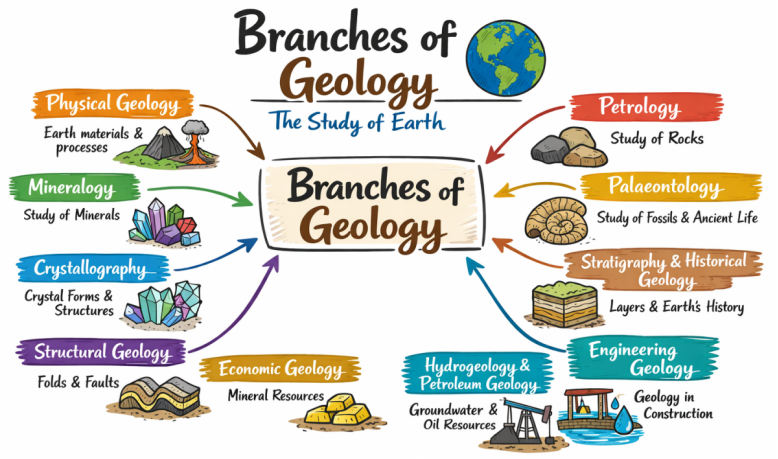
4. BRANCHES OF GEOLOGY
Geology is divided into several branches to study Earth in detail:
1. Physical (General) Geology – studies Earth materials and processes operating on and beneath the surface.
2. Mineralogy – study of minerals, their properties, composition, and occurrence.
3. Crystallography – study of crystal forms and structures
4. Petrology – study of rocks, their origin, classification, and composition.
5. Palaeontology – study of fossils and ancient life.
6. Stratigraphy & Historical Geology – study of rock layers and Earth’s history through time.
7. Structural Geology – study of folds, faults, and deformation of rocks.
8. Economic Geology – study of mineral deposits and their exploration.
9. Engineering Geology – application of geology to construction and engineering works.
10. Hydrogeology & Petroleum Geology – study of groundwater and petroleum resources.
These branches collectively help in understanding both theoretical and practical aspects of Earth science.
(Source; The image was generated by an AI model (DALL·E by OpenAI))
5. APPLICATIONS OF GEOLOGY
§ Geology has wide applications in human life and development:
§ Exploration of minerals, coal, petroleum, and natural gas.
§ Groundwater investigation and management.
§ Site selection for dams, bridges, tunnels, and buildings.
§ Identification of construction materials and soil stability.
§ Natural hazard studies such as earthquakes, landslides, and volcanic activity.
§ Environmental management and land-use planning.
§ Support for agriculture through
Because many industries depend on Earth resources, geological knowledge is essential for national development and resource conservation.
6. DEVELOPMENT OF GEOLOGY
The development of geology has evolved from ancient philosophical ideas to modern scientific understanding. Early civilizations believed the Earth occupied a central position in the universe (geocentric view). Later, scientific observations led to the heliocentric model, placing the Sun at the center of the solar system.
Modern geology began during the eighteenth century, especially with the work of James Hutton, who introduced the principle of "Uniformitarianism", stating that “the present is the key to the past.” This principle explains that geological processes operating today also operated in the past. Other important concepts such as original horizontal and the law of superposition helped explain rock formation and Earth history. These ideas laid the foundation for modern geological science.
7. RELATIONSHIP WITH OTHER SCIENCES
Geology is an interdisciplinary science closely connected with many other fields:
a) Physics – understanding Earth’s physical properties and geophysical methods.
b) Chemistry – chemical composition of rocks and minerals (geochemistry).
c) Biology – study of fossils and evolution of life.
d) Mathematics – data analysis and modelling.
e) Meteorology – study of atmosphere and climate interactions.
f) Oceanography – study of oceans and marine geology.
g) Engineering Sciences – application of geology in construction and infrastructure.
Because Earth processes involve physical, chemical, and biological changes, geology overlaps with many scientific disciplines.
7. SUMMARY
Geology is the science of the Earth that studies its materials, structure, origin, and processes. Its scope includes understanding Earth’s history, natural phenomena, and resource distribution. The subject is divided into several branches such as mineralogy, petrology, structural geology, and economic geology, each focusing on specific aspects of Earth science. Geological knowledge has practical applications in resource exploration, engineering projects, groundwater studies, and environmental management. The development of geology from early ideas to modern scientific principles, especially uniformitarianism, has shaped our understanding of Earth’s evolution. Geology also maintains strong relationships with physics, chemistry, biology, and other sciences, making it an essential interdisciplinary field.
2. UNIT-2 SOLAR SYSTEM
The Solar System is made up of the Sun and all objects that move around it because of gravity. These include planets, moons, asteroids, comets, and dwarf planets.
The Solar System formed about 4.6 billion years ago from a cloud of gas and dust. The Sun contains most of the mass of the Solar System. The planets revolve around the Sun in nearly circular paths called orbits.
Let us now move forward and explore our dynamic planet in greater detail.
1. OBJECTIVES
After studying this unit, you should be able to:
Ø Describe the structure and components of the solar system
Ø Explain the formation and evolution of the solar system
Ø Identify planets and their characteristics
Ø Understand the role of the Sun in the solar system
2. STRUCTURE AND COMPOSITION
The Solar System consists of the Sun, planets, moons, asteroids, comets, and other small bodies. The Sun is at the center and contains about 99.86% of the total mass of the Solar System.
The planets revolve around the Sun in almost circular paths called orbits and lie mostly in a flat plane known as the ecliptic plane. The Solar System is divided into:
Inner Solar System – includes the four rocky planets and the asteroid belt.
Outer Solar System – includes giant planets and icy objects beyond Neptune.
Inner planets are mainly made of rock and metals, while outer planets contain gases and ices. The distribution of materials depends on distance from the Sun and temperature conditions.
3. DISTANCES AND SCALES
Distances in the Solar System are very large, so astronomers use the unit called Astronomical Unit (AU).
1 AU = average distance between Earth and the Sun = 150 million km.
Inner planets are closer to the Sun and move faster.
Outer planets are farther away and take more time to complete one revolution.
Example:
1) Mercury is closest to the Sun.
2) Neptune is about 30 AU away from the Sun.
3) As distance from the Sun increases, the space between planetary orbits also increases.
Sun
The Sun is a star and the main source of energy in the Solar System. It controls the movement of all planets through its gravity.
Key points:
· Composed mainly of hydrogen and helium.
· Produces energy through nuclear fusion, where hydrogen changes into helium.
· Releases heat and light as electromagnetic radiation.
· Provides light, warmth, and energy necessary for life on Earth.
· The large mass of the Sun makes it the dominant body of the Solar System.
PLANETS
There are eight major planets in the Solar System.
Inner (Terrestrial) Planets
· Mercury – smallest and closest planet.
· Venus – hottest planet with thick atmosphere.
· Earth – only planet known to support life.
· Mars – red planet with thin atmosphere.
These planets are rocky, smaller in size, and have few or no moons.
Outer (Giant) Planets
· Jupiter – largest planet; gas giant.
· Saturn – famous for its rings.
· Uranus – ice giant that rotates on its side.
· Neptune – farthest planet with strong winds.
Outer planets are larger and mainly made of gases and ices.
Pluto (Dwarf Planet)
Pluto is now classified as a dwarf planet located beyond Neptune. Pluto was once considered the ninth planet of the Solar System but is now classified as a dwarf planet. It is located in the Kuiper Belt beyond Neptune. Pluto is small, icy, and follows an elliptical orbit around the Sun. It has a large moon called Charon, and together they form a unique planetary system.
PLANETS:
(Quick Memory Trick for Order of Planets)
(M V E M J S U N)
My Very Easy Method Just Shows Us Names

(Source; The image was generated by an AI model (DALL·E by OpenAI))
SUMMARY
The Solar System formed about 4.6 billion years ago and consists of the Sun at the center and planets orbiting around it. The Sun contains most of the system’s mass and supplies energy through nuclear fusion. Planets are divided into inner rocky planets and outer giant planets. Distances are measured using the Astronomical Unit (AU). Earth is the only known planet supporting life. The Solar System also contains moons, asteroids, comets, and dwarf planets such as Pluto. Understanding the Solar System helps us learn about Earth’s origin and its place in space.
3. UNIT-3 EARTH
This unit focuses on Earth, the only known planet that supports life, and explains its origin, age, shape, and internal structure. Students will learn about the crust, mantle, and core and their role in geological activities such as earthquakes, volcanism, and mountain building. The unit introduces internal and external geological processes that continuously shape Earth’s surface through weathering, erosion, and deposition. It also highlights how plate movements drive major changes in the planet over long periods of time. Understanding the interaction between the lithosphere, hydrosphere, and atmosphere helps explain Earth as a dynamic and interconnected system. This foundation prepares learners for advanced concepts in physical geology.
Objectives
After studying this unit, you should be able to:
Explain the origin and age of the Earth
Describe the shape and size of the Earth
Understand the internal structure (crust, mantle, core)
Explain major geological processes
1. Origin of the Earth
Several theories were proposed to explain the origin of Earth:
Nebular Hypothesis – Earth formed from a hot gaseous cloud.
Planetesimal and Tidal Hypotheses – planets formed from fragments pulled from the Sun.
Modern Theory – Earth and the Solar System formed about 4.6 billion years ago from a huge cloud of gas and dust produced by exploding stars.
As the cloud contracted, the Sun formed at the center, while rocky materials formed the inner planets. Early Earth became very hot, allowing heavy materials like iron to sink toward the center and lighter materials to form the crust. Volcanic gases formed the early atmosphere, and later cooling allowed water to form oceans.
2. Age of the Earth
Scientists estimate Earth’s age using radiometric dating of rocks and meteorites. Earth’s oldest rocks are more than 4 billion years old. Studies of meteorites and moon rocks suggest that Earth formed around 4.54 billion years ago. This age is widely accepted because evidence from many sources gives similar results.
3. Shape and Size of the Earth
Earth is not a perfect sphere. It is slightly flattened at the poles and bulged at the equator, giving it an oblate spheroid shape (geoid).
Key facts:
Equatorial diameter ≈ 12,756 km
Polar diameter ≈ 12,714 km
Average specific gravity ≈ 5.5
The difference in shape is mainly due to Earth’s rotation. Mountains and ocean depths are small compared to Earth’s overall size.
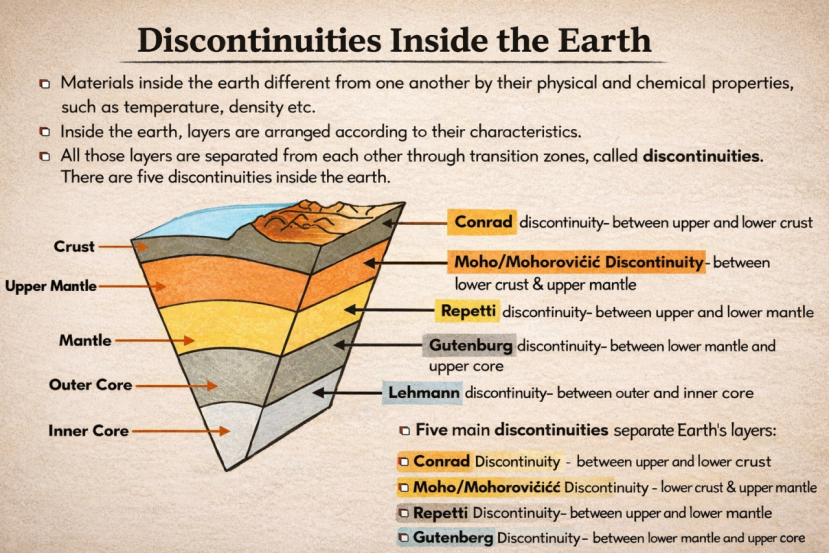
4. Internal Structure of the Earth
Earth has three main layers:
a. Crust
Thin outer solid layer.
Thickness varies: thinner below oceans and thicker under mountains.
Made mostly of rocks rich in silica and alumina.
b. Mantle
Lies below the crust up to about 2,900 km depth.
Dense, hot, and rich in iron and magnesium.
Source of many geological processes like volcanism and plate movement.
c. Core
Innermost layer of Earth.
Composed mainly of iron and nickel.
Outer core is liquid, inner core is solid.
Very high temperature and density.
These layers are identified mainly using seismic wave studies.
https://youtube.com/clip/UgkxWPNSUZ8sYJyYFo28_cWP6klWr5xQ2kvr?si=c_VmS31DrFDjA2n4

(Source: AI-generated diagram (OpenAI DALL·E)