Block-1 Resources
3. UNIT-3 EARTH
This unit focuses on Earth, the only known planet that supports life, and explains its origin, age, shape, and internal structure. Students will learn about the crust, mantle, and core and their role in geological activities such as earthquakes, volcanism, and mountain building. The unit introduces internal and external geological processes that continuously shape Earth’s surface through weathering, erosion, and deposition. It also highlights how plate movements drive major changes in the planet over long periods of time. Understanding the interaction between the lithosphere, hydrosphere, and atmosphere helps explain Earth as a dynamic and interconnected system. This foundation prepares learners for advanced concepts in physical geology.
Objectives
After studying this unit, you should be able to:
Explain the origin and age of the Earth
Describe the shape and size of the Earth
Understand the internal structure (crust, mantle, core)
Explain major geological processes
1. Origin of the Earth
Several theories were proposed to explain the origin of Earth:
Nebular Hypothesis – Earth formed from a hot gaseous cloud.
Planetesimal and Tidal Hypotheses – planets formed from fragments pulled from the Sun.
Modern Theory – Earth and the Solar System formed about 4.6 billion years ago from a huge cloud of gas and dust produced by exploding stars.
As the cloud contracted, the Sun formed at the center, while rocky materials formed the inner planets. Early Earth became very hot, allowing heavy materials like iron to sink toward the center and lighter materials to form the crust. Volcanic gases formed the early atmosphere, and later cooling allowed water to form oceans.
2. Age of the Earth
Scientists estimate Earth’s age using radiometric dating of rocks and meteorites. Earth’s oldest rocks are more than 4 billion years old. Studies of meteorites and moon rocks suggest that Earth formed around 4.54 billion years ago. This age is widely accepted because evidence from many sources gives similar results.
3. Shape and Size of the Earth
Earth is not a perfect sphere. It is slightly flattened at the poles and bulged at the equator, giving it an oblate spheroid shape (geoid).
Key facts:
Equatorial diameter ≈ 12,756 km
Polar diameter ≈ 12,714 km
Average specific gravity ≈ 5.5
The difference in shape is mainly due to Earth’s rotation. Mountains and ocean depths are small compared to Earth’s overall size.
4. Internal Structure of the Earth
Earth has three main layers:
a. Crust
Thin outer solid layer.
Thickness varies: thinner below oceans and thicker under mountains.
Made mostly of rocks rich in silica and alumina.
b. Mantle
Lies below the crust up to about 2,900 km depth.
Dense, hot, and rich in iron and magnesium.
Source of many geological processes like volcanism and plate movement.
c. Core
Innermost layer of Earth.
Composed mainly of iron and nickel.
Outer core is liquid, inner core is solid.
Very high temperature and density.
These layers are identified mainly using seismic wave studies.
https://youtube.com/clip/UgkxWPNSUZ8sYJyYFo28_cWP6klWr5xQ2kvr?si=c_VmS31DrFDjA2n4
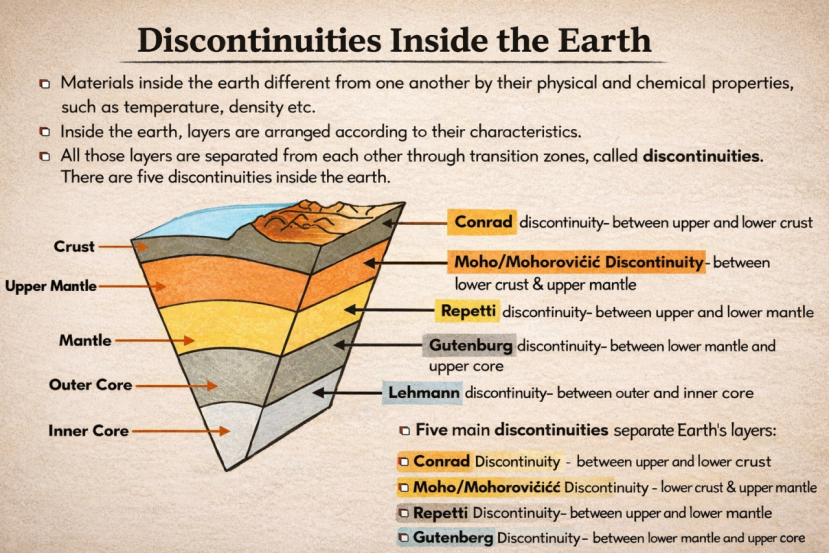

(Source: AI-generated diagram (OpenAI DALL·E)