Block-1 Resources
1. UNIT-1 SCOPE AND DEVELOPMENT OF GEOLOGY
The unit introduces major branches of geology and key historical ideas like uniformitarianism that guide geological thinking. Understanding geology is essential for resource exploration, environmental management, engineering, and disaster awareness.
1. OBJECTIVES
After studying this unit, you should be able to:
Ø Define the science of geology
Ø Explain the scope and importance of geology
Ø Describe the branches of geology
Ø Understand the development of geology as a science
Ø Explain the relationship between geology and other sciences
2. GEOLOGY DEFINITION/WHAT IS GEOLOGY?
Geology is the science of the Earth. It studies:
§ How the Earth was formed
§ What the Earth is made of (rocks and minerals)
§ How mountains, rivers, and oceans are formed
§ Natural events like earthquakes and volcanoes
§ In simple words, geology helps us understand our planet.
3. SCOPE OF GEOLOGY
Geology is the science that studies the Earth, its origin, structure, materials, and the natural processes acting on and within it. The scope of geology is very wide because it attempts to understand the complete evolution of the Earth from its formation to the present day. It explains natural phenomena such as volcanoes, earthquakes, mountain building, rivers, glaciers, and the formation of landforms. Geology also helps answer fundamental questions about the origin of life and the history of Earth.
Modern geology uses knowledge from many sciences to interpret Earth processes and reconstruct past environments. The subject has great economic importance because natural resources such as minerals, fossil fuels, soils, and groundwater are all Earth products. Therefore, geology plays a key role in resource exploration, environmental understanding, and sustainable development.
4. BRANCHES OF GEOLOGY
Geology is divided into several branches to study Earth in detail:
1. Physical (General) Geology – studies Earth materials and processes operating on and beneath the surface.
2. Mineralogy – study of minerals, their properties, composition, and occurrence.
3. Crystallography – study of crystal forms and structures
4. Petrology – study of rocks, their origin, classification, and composition.
5. Palaeontology – study of fossils and ancient life.
6. Stratigraphy & Historical Geology – study of rock layers and Earth’s history through time.
7. Structural Geology – study of folds, faults, and deformation of rocks.
8. Economic Geology – study of mineral deposits and their exploration.
9. Engineering Geology – application of geology to construction and engineering works.
10. Hydrogeology & Petroleum Geology – study of groundwater and petroleum resources.
These branches collectively help in understanding both theoretical and practical aspects of Earth science.
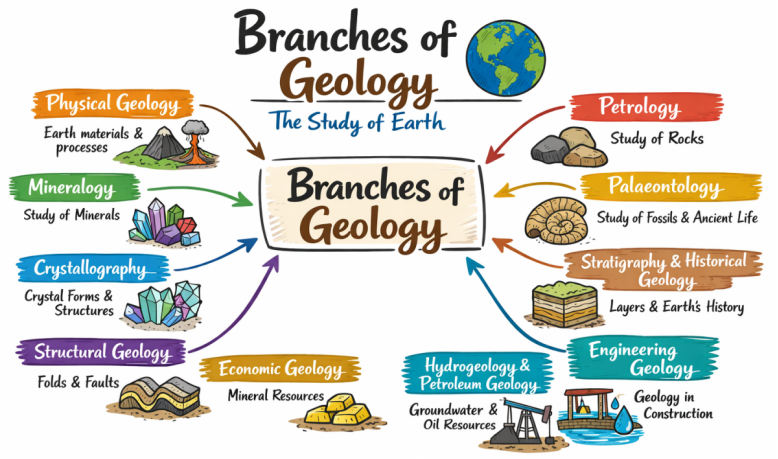
(Source; The image was generated by an AI model (DALL·E by OpenAI))
5. APPLICATIONS OF GEOLOGY
§ Geology has wide applications in human life and development:
§ Exploration of minerals, coal, petroleum, and natural gas.
§ Groundwater investigation and management.
§ Site selection for dams, bridges, tunnels, and buildings.
§ Identification of construction materials and soil stability.
§ Natural hazard studies such as earthquakes, landslides, and volcanic activity.
§ Environmental management and land-use planning.
§ Support for agriculture through
Because many industries depend on Earth resources, geological knowledge is essential for national development and resource conservation.
6. DEVELOPMENT OF GEOLOGY
The development of geology has evolved from ancient philosophical ideas to modern scientific understanding. Early civilizations believed the Earth occupied a central position in the universe (geocentric view). Later, scientific observations led to the heliocentric model, placing the Sun at the center of the solar system.
Modern geology began during the eighteenth century, especially with the work of James Hutton, who introduced the principle of "Uniformitarianism", stating that “the present is the key to the past.” This principle explains that geological processes operating today also operated in the past. Other important concepts such as original horizontal and the law of superposition helped explain rock formation and Earth history. These ideas laid the foundation for modern geological science.
7. RELATIONSHIP WITH OTHER SCIENCES
Geology is an interdisciplinary science closely connected with many other fields:
a) Physics – understanding Earth’s physical properties and geophysical methods.
b) Chemistry – chemical composition of rocks and minerals (geochemistry).
c) Biology – study of fossils and evolution of life.
d) Mathematics – data analysis and modelling.
e) Meteorology – study of atmosphere and climate interactions.
f) Oceanography – study of oceans and marine geology.
g) Engineering Sciences – application of geology in construction and infrastructure.
Because Earth processes involve physical, chemical, and biological changes, geology overlaps with many scientific disciplines.
7. SUMMARY
Geology is the science of the Earth that studies its materials, structure, origin, and processes. Its scope includes understanding Earth’s history, natural phenomena, and resource distribution. The subject is divided into several branches such as mineralogy, petrology, structural geology, and economic geology, each focusing on specific aspects of Earth science. Geological knowledge has practical applications in resource exploration, engineering projects, groundwater studies, and environmental management. The development of geology from early ideas to modern scientific principles, especially uniformitarianism, has shaped our understanding of Earth’s evolution. Geology also maintains strong relationships with physics, chemistry, biology, and other sciences, making it an essential interdisciplinary field.